Perception · A DIFFERENT PERSPECTIVE
Your Brain Experiences the Past, Not the Present
The present moment is not as immediate as it feels. A closer look at the hidden delay in everything you experience.
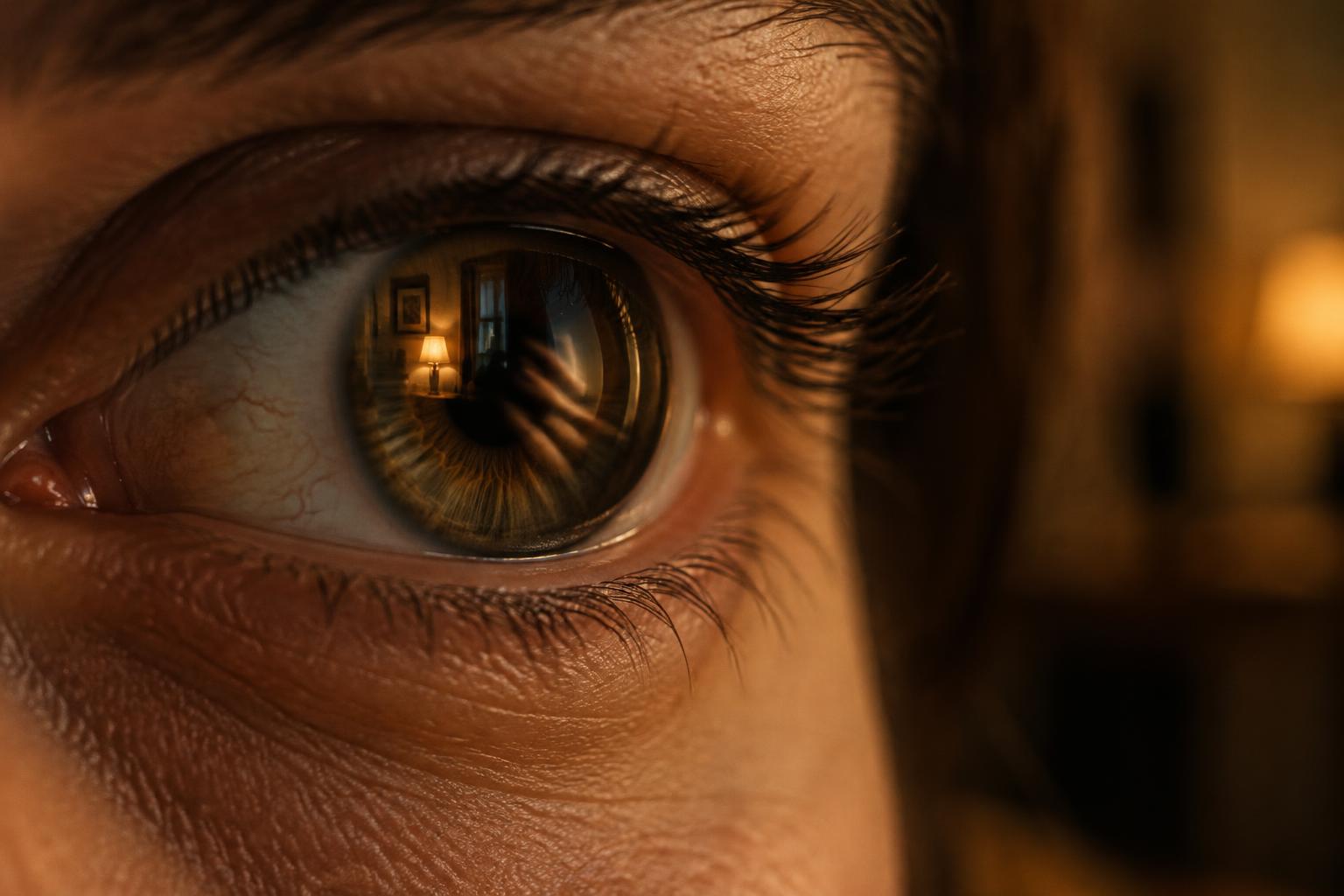
No. Every sensation you register, from a hand brushing your arm to a light flicking on across the room, is already a fraction of a second old by the time it reaches awareness. Your brain receives signals at different speeds, processes them through several relay stations, and then stitches the results into a single, seamless scene it presents to you as now. What you call the present moment is better described as a carefully edited rebroadcast of the very recent past.
The lag built into every sense
Light travels fast, but the biology that turns light into vision does not. When photons strike the retina, they trigger a chain of chemical reactions in photoreceptor cells, then a cascade of electrical signals that pass through several layers of retinal neurons before a signal ever leaves the eye along the optic nerve. From there it travels to the thalamus, then to the primary visual cortex at the back of the skull, and only after that to higher areas that extract motion, color, and meaning. Each handoff costs time. Estimates for the whole chain, from photon to conscious visual experience, commonly fall in the range of one hundred to several hundred milliseconds depending on the complexity of the scene and how dim or bright it is.
Hearing is faster at the periphery, since the cochlea converts sound into neural signals very quickly, but the brainstem and cortex still need tens of milliseconds to localize and interpret a sound. Touch depends on where on the body the stimulus occurs, because nerve conduction speed and travel distance both matter. A touch on the face reaches the brain sooner than a touch on the toe, simply because the toe's nerves have farther to travel. These differences are not trivial footnotes. They mean that if a light flashes and a sound plays at the exact same physical instant, your brain does not receive them at the same time, and in some cases does not even perceive them as simultaneous unless it actively corrects for the mismatch.
This is the first reason to doubt that we experience a literal present. The raw material of perception already arrives staggered and delayed, sense by sense, body part by body part. The feeling of a unified instant, where sight, sound, and touch all seem to happen together, is not given for free by the sensory organs. It has to be constructed.
Binding the senses into one scene
The brain's solution to staggered input is to wait. Research on multisensory integration suggests the nervous system holds different incoming signals briefly, within a window wide enough to catch the slowest relevant stream, and then binds them together into a single perceived event. This is sometimes described as a kind of editorial deadline: the brain does not report an experience until enough of the pieces have arrived to make a coherent whole, and it then synchronizes the final presentation so you are not aware of the underlying mismatches.
This binding process can be measured in laboratories using simple synchrony judgment tasks, where a participant is asked whether a flash and a beep happened at the same time while the experimenters vary the delay between them. People reliably tolerate a range of delays, often tens of milliseconds, before noticing any asynchrony. That tolerance is itself evidence of editing: the brain is not passively recording timing, it is actively deciding what counts as simultaneous for the purposes of conscious experience.
The cost of this waiting is a kind of running delay between the world and awareness. Several neuroscientists have argued that conscious experience is less like a live video feed and more like a slightly buffered stream, always trailing reality by some small but real margin. The exact size of that margin remains debated and almost certainly varies by task and sensory modality, but the general principle, that perception is assembled rather than instantaneous, is well supported.
Postdiction and the flash-lag effect
If perception were a straightforward recording of events in the order they happened, the brain would never need information from after an event to interpret that event. Yet it clearly does. This phenomenon is called postdiction, and it means that what you perceive at one moment can be shaped by what arrives microseconds or milliseconds later. The brain is willing to revise its story of the recent past based on new incoming evidence before that story is ever delivered to consciousness.
The flash-lag effect is one of the most studied demonstrations of this. In a typical setup, a bright spot moves steadily across a screen, and at some point a brief flash appears at the same location as the moving spot. Observers consistently report that the moving spot appeared ahead of the flash, even though at the instant of the flash the two were in exactly the same place. One influential explanation is that the brain extrapolates the trajectory of the moving object forward in time to compensate for neural processing delays, which would otherwise make moving objects appear to lag behind their true position. The flash, being a single unpredictable event, gets no such extrapolation, so it appears to trail behind.
Other explanations for the flash-lag effect exist, including ones based on differential processing latency between the flash and the continuously moving object, or on the fact that perception might sample position over a short time window rather than at a single instant. The scientific debate over exactly which mechanism is correct is ongoing, but all of the leading explanations agree on the deeper point: what you see as the current position of a moving object is a prediction or a reconstruction, not a direct readout of where the object was at the sampled instant.
Postdictive effects turn up elsewhere too, including in studies of apparent motion and in the cutaneous rabbit illusion, where a sequence of taps delivered to a few points on the skin is felt as a smooth hopping sensation across locations that were never actually touched. In each case, the brain is shown to be assembling a narrative after the fact, using later information to shape the reported timing and location of earlier events.
The Libet experiments and their contested meaning
In the early 1980s, the physiologist Benjamin Libet ran a set of experiments that became some of the most cited and most argued-over results in the science of consciousness. Participants were asked to make a spontaneous, self-initiated finger movement whenever they felt the urge, while watching a fast-moving clock so they could report the exact moment they became aware of their intention to move. Libet recorded a slow buildup of electrical activity over the motor cortex, known as the readiness potential, that began several hundred milliseconds before participants reported becoming consciously aware of their decision to act.
Libet interpreted this as evidence that the brain initiates an action before conscious awareness of the decision arises, which raised the question of whether conscious will causes action or merely registers a decision that unconscious processes have already made. This interpretation has been enormously influential in public discussions of free will, but it has also drawn sustained methodological criticism. Critics have questioned whether a person can accurately time an inner experience against a clock, whether the readiness potential actually reflects a specific decision rather than general preparatory brain noise that happens to precede many kinds of events, and whether the simple button-press task used in the experiment can tell us much about complex, deliberated decisions in ordinary life.
Later studies using different methods, including a widely cited 2008 study that used machine learning to decode fMRI activity, found choice-predictive brain signals up to about ten seconds before participants reported becoming aware of their decision, though decoding accuracy was modest, around 60 percent, well short of certainty, and other work has suggested the readiness potential itself may reflect accumulating random fluctuations crossing a threshold rather than a discrete unconscious decision. The scientific community has not reached consensus on what the readiness potential actually represents, or on what any of this implies for free will, and claims that the Libet paradigm has settled the philosophical question should be treated with real caution.
What is less contested is the narrower, more modest point relevant to this article: Libet's own timing data depend on the same kind of delayed, reconstructed perception described in the sections above. The very act of introspectively timing an inner experience is itself a perceptual judgment, assembled with a delay, which is one more reason the clean story of a crisp conscious now, arriving at a precise instant, does not survive close examination.
Why the lag usually goes unnoticed
If perception trails reality by a measurable margin, a reasonable question is why this delay almost never becomes apparent in daily life. Part of the answer is that the delay is consistent. The same approximate lag applies continuously, so there is no jarring before-and-after contrast the way there would be if the delay varied wildly from moment to moment. A system that is uniformly late, but reliably so, can still support fast reactions and coordinated movement, because the brain can learn to anticipate and compensate for its own processing time.
Predictive processing is one influential framework for understanding this compensation. Under this view, the brain is constantly generating forward models of what is about to happen, based on recent patterns, and conscious perception reflects a blend of incoming sensory data and these predictions. This would help explain why skilled athletes can hit a fast-moving ball despite neural delays, and why the flash-lag effect specifically affects predictable, continuously moving stimuli more than unpredictable discrete ones. Prediction is one of the brain's main tools for papering over the gap between when something happens and when it can be consciously registered.
None of this means perception is unreliable or useless. The delay is small enough, and the brain's corrective machinery good enough, that human perception remains an excellent practical guide to the world for almost every purpose, from catching a dropped cup to holding a conversation. The philosophical interest lies not in proving perception untrustworthy but in showing that something as basic and intuitive as the feeling of a live, immediate present turns out to be an achievement of biological engineering rather than a simple fact of how consciousness works.
SOURCES AND FURTHER READING
- Benjamin Libet, Unconscious cerebral initiative and the role of conscious will in voluntary action Behavioral and Brain Sciences
- Free Will Stanford Encyclopedia of Philosophy
- Temporal Consciousness Stanford Encyclopedia of Philosophy
- The Neuroscience of Consciousness Stanford Encyclopedia of Philosophy
- Unconscious determinants of free decisions in the human brain Soon, Brass, Heinze and Haynes, Nature Neuroscience, 2008