Identity · A DIFFERENT PERSPECTIVE
Who Are You When Everything Changes?
Your memories, your body, your beliefs. Is there a self beneath it all?
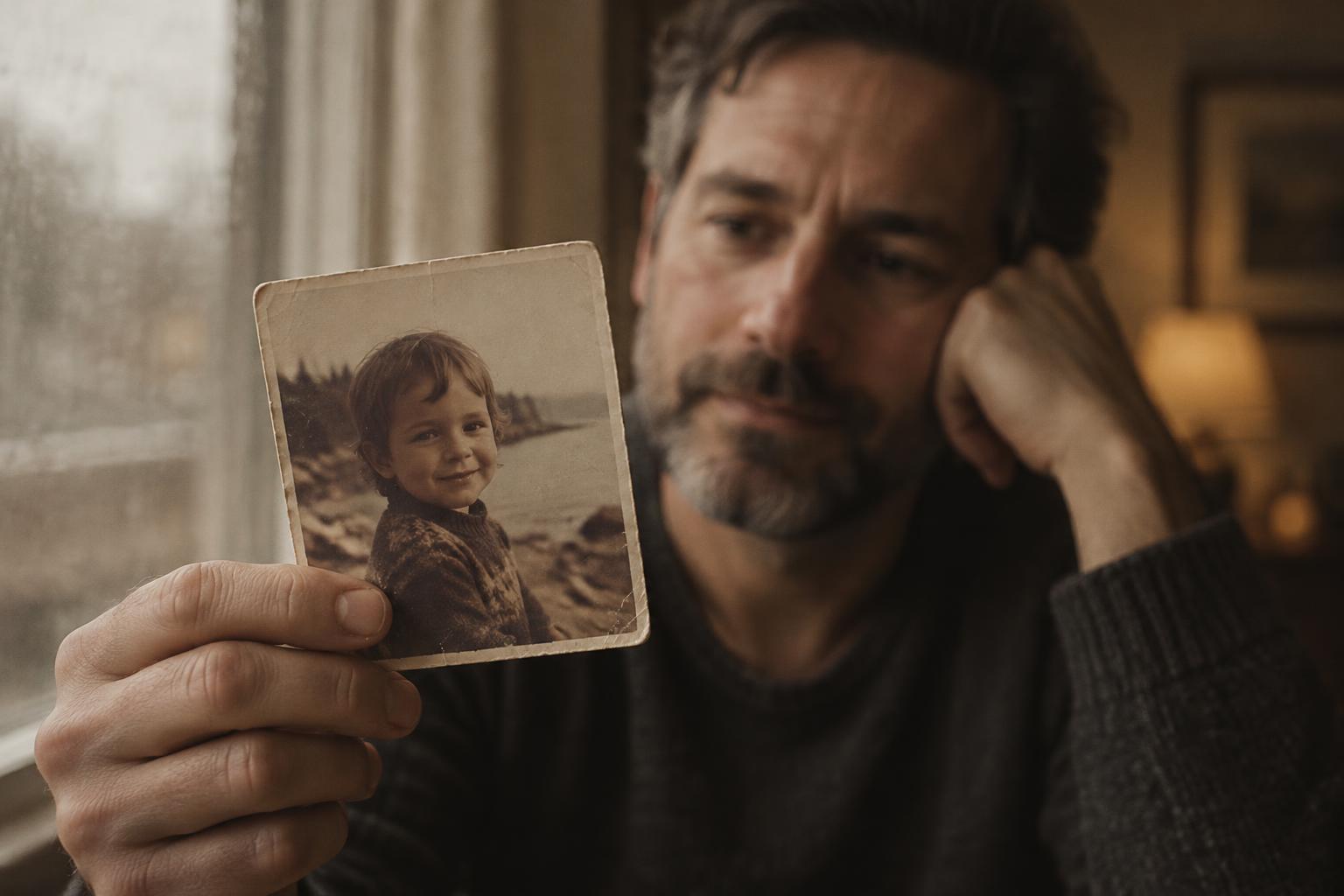
You are not a fixed, unchanging thing but a pattern that persists through continuous change, held together less by any single unchanging substance than by overlapping chains of memory, psychological connection, and bodily continuity. Philosophers from Locke to Parfit have argued that personal identity over time is best understood through these overlapping connections rather than through a single essential self, while Hume and the bundle theory tradition go further, questioning whether a persisting self exists at all beneath the stream of experiences. Neuroscience adds that even the brain's own representation of a unified self is itself a constructed, revisable process rather than evidence of a single enduring entity.
The old puzzle of the ship
The Ship of Theseus is one of the oldest identity puzzles in Western philosophy, traced back to accounts by Plutarch of a ship preserved by Athenians who replaced its rotting planks one at a time over many years, until eventually no original plank remained. The puzzle asks whether the fully restored ship is still the same ship it was at the start, and a sharper version adds a twist: if someone collected all the discarded original planks and reassembled them into a second ship, which of the two, the continuously repaired vessel or the reconstructed original, would be the true Ship of Theseus.
The puzzle matters beyond wooden ships because the same structure applies directly to human bodies and minds. Nearly every cell in the human body is replaced over time, memories fade and are reconstructed rather than played back like a recording, beliefs and personality traits shift across a lifetime, and yet people confidently refer to themselves at five years old and at eighty years old as the same person. The Ship of Theseus forces the question of what, exactly, is doing the work of making that true, if it is true at all, since neither the material parts nor the pattern of organization stays constant for even a single day.
Philosophers have offered different candidate answers to what grounds identity through change: some form of physical continuity, some form of psychological continuity, or some looser notion of a persisting narrative that a person and the people around them simply agree to treat as continuous. Each answer handles some cases well and runs into trouble with others, and much of the modern philosophy of personal identity can be read as an extended argument about which of these candidates, if any, deserves to be called the real criterion.
Locke and memory as the thread of identity
John Locke, writing in the late seventeenth century, proposed an influential answer by separating the question of what makes the same human being from what makes the same person. A human being, for Locke, is a biological organism, identified the way any living body is, through continuous organization of matter over time. A person, by contrast, is a thinking, self-aware being, and what makes a person at one time the same person as someone at an earlier time is not sameness of body or substance but continuity of consciousness, specifically the capacity to remember, from the inside, having had earlier experiences.
This memory-based account had a clear motivation: it let Locke explain cases where our ordinary judgments about identity and our judgments about moral responsibility come apart from simple physical continuity. If a prince's consciousness, memories and all, were somehow transferred into a cobbler's body, Locke argued, everyone would say the resulting person is the prince, not the cobbler, even though the body is entirely the cobbler's. Memory, on this view, is the thread that makes a past self and a present self the same person, regardless of what has happened to the underlying body.
Locke's theory faced an immediate and famous objection, raised by Thomas Reid not long after, known as the brave officer problem. Imagine an old general who remembers an act of bravery he performed as a young officer, and as a young officer he remembered, at the time, having been flogged as a schoolboy, but by the time he is a general, he has entirely forgotten the schoolboy flogging. By Locke's criterion, the general is the same person as the young officer, because he remembers that episode, and the young officer is the same person as the schoolboy, because he remembered that episode. But the general does not remember being the schoolboy at all, which by strict application of Locke's memory criterion would mean the general is not the same person as the schoolboy, even though identity is supposed to be transitive. This contradiction exposed a real gap in the simple memory theory that later philosophers would spend considerable effort trying to repair.
Hume and the bundle theory
David Hume pushed the skepticism further than Locke had, questioning not just what makes a self persist but whether there is any unified self to be found at all. In his examination of his own mind, Hume reported that whenever he looked inward, searching for a self distinct from his particular perceptions, he never caught himself without a perception, and never found anything that was not a specific thought, feeling, or sensation. He concluded that what we call the self is not a single unified thing underlying experience but rather a bundle of different perceptions, succeeding each other with inconceivable rapidity, held together only by relations of resemblance and causation between them, somewhat like how we think of a single river despite its water constantly changing.
This bundle theory of the self denies that there is any further fact, beyond the collection of mental states and their relations to each other, that makes them belong to one self rather than being a mere aggregate. On this view, the feeling of being a single, continuous subject standing behind all one's experiences is itself something to be explained rather than taken for granted, possibly a kind of useful illusion generated by the way memory and attention link experiences together into an apparently seamless narrative.
Hume's position remains one of the most radical in the philosophy of personal identity because it does not simply propose a different criterion for what makes a self persist, in the way Locke's memory theory does, it questions the existence of the persisting entity in the first place. If Hume is right, questions like whether you are the same person you were ten years ago are, in an important sense, built on a false premise, since there was never a single self there to begin with, only a connected series of mental events.
Parfit and what matters in survival
In the twentieth century, Derek Parfit took up Locke's and Hume's lines of thought and pushed them toward a startling practical conclusion. Parfit developed an extensive series of thought experiments, including cases of gradual brain replacement and teleportation style duplication, to argue that personal identity, strictly defined as a one to one relation of numerical sameness over time, is not actually what matters to us when we care about our own survival. What matters, Parfit argued, is psychological continuity and connectedness, meaning overlapping chains of memory, intention, belief, and personality that link a person at one time to a person at another time, even if that chain does not meet the strict logical requirements of one to one identity.
His most famous thought experiment imagined a teleporter that destroys a person's body on Earth while creating an exact physical and psychological duplicate on Mars. Ordinary intuition says this might or might not count as survival, but Parfit pressed further by imagining a case where the Earth body is not destroyed, so that two psychologically continuous people now exist, one on Earth and one on Mars. Since identity is normally understood as a relation that can hold between only one thing and itself, both resulting people cannot be identical to the original, yet both stand in exactly the same psychological relationship to that original person that would normally be called survival. Parfit took this to show that strict identity is not doing the work we think it is doing, and that what we actually care about, psychological continuity, can come in degrees and can even branch, something strict numerical identity cannot do.
The practical upshot of Parfit's view was a kind of reduced emphasis on the self as a deep, separately existing fact. He argued that personal identity is less like an unbreakable metaphysical rod connecting your past and future selves and more like a rope made of many overlapping fibers, none of which runs the entire length, so that identity over long stretches of a life may be a looser, more gradual matter than our ordinary language suggests. This had implications Parfit took seriously for ethics and self-interest, suggesting that the sharp line we draw between self-concern and concern for others might be less absolute than it feels.
Psychological continuity in practice
Outside of thought experiments, psychological continuity theories have to deal with the messy, graded way real human lives actually change. A person's memories, values, and personality shift gradually across decades, sometimes so much that someone looking back at their twenty year old self experiences a real sense of discontinuity, a feeling systematically studied by psychologists under what has been called the end of history illusion, the tendency for people to underestimate how much their own personality and preferences will continue to change in the future even while accurately recognizing how much they have already changed in the past.
Psychological continuity theory handles ordinary cases, like gradual change over a normal life, reasonably well, by treating identity as a matter of overlapping links between adjacent time slices of a person rather than requiring that the person at eighty share direct memories with the person at five. But it faces harder cases at the edges: conditions like severe amnesia, dissociative identity disorder, or advanced dementia disrupt the chain of psychological connections in ways that make simple application of the theory genuinely difficult, raising real ethical questions about continuity of rights, consent, and relationships when psychological links are badly broken rather than merely gradually shifted.
These edge cases are not merely academic. They have mattered directly in legal and medical contexts, for instance in debates about advance directives written by a person before severe dementia, where the question of whether the person who wrote the directive and the person later living with advanced dementia are usefully treated as the same person for the purposes of honoring earlier wishes, is a live and practically consequential version of the philosophical puzzle, not simply an abstract exercise.
What neuroscience adds
Neuroscience approaches the self from a different angle, asking how the brain constructs the felt sense of being a single, continuous subject rather than asking what philosophically justifies calling two time slices the same person. Research on the default mode network, a set of interacting brain regions active during rest and self-referential thought, has linked this network to tasks involving autobiographical memory, imagining the future, and reflecting on one's own traits, suggesting that the sense of a continuous self is actively constructed and maintained by specific, identifiable neural processes rather than simply observed by some separate inner witness.
Studies of split brain patients, whose corpus callosum connecting the brain's two hemispheres has been surgically severed, have shown that each hemisphere can, under controlled experimental conditions, process information and even generate responses somewhat independently, raising difficult questions about whether such patients house one integrated self or something more like two more loosely coordinated centers of processing that ordinarily cooperate seamlessly enough to feel unified. These findings do not resolve the philosophical debate, but they give it empirical texture, showing that the brain's unity, which underwrites our everyday sense of being one continuous self, is itself a contingent, biologically implemented achievement rather than a metaphysical given.
Taken together, the neuroscience lends some support to the Humean picture: there is no single location in the brain where a unified self sits watching experience unfold, only distributed, interacting processes that, under normal conditions, generate a strong and useful sense of continuity. Whether this means the self is therefore an illusion in some deflationary sense, or simply that the self is a real but distributed and constructed phenomenon rather than a simple unified substance, is an interpretive question neuroscience alone does not settle, and philosophers continue to disagree about how to read the same body of findings.
SOURCES AND FURTHER READING
- Personal Identity Stanford Encyclopedia of Philosophy
- Reasons and Persons Derek Parfit, Oxford University Press
- Material Constitution Stanford Encyclopedia of Philosophy
- Personal Identity Internet Encyclopedia of Philosophy
- The Brain's Default Network Buckner, Andrews-Hanna and Schacter, Annals of the New York Academy of Sciences, 2008
- The End of History Illusion Quoidbach, Gilbert and Wilson, Science, 2013